The Class: Incidentally,
the subject was on “International Relations and Diplomatic Practices,” which
was both course related and career oriented at the same time. Since
International Relations focused more on theories and concepts, the course
provided an opportunity to discuss the application of these abstract ideas through
diplomacy in actual situations.
 The Book: FSO IV:
Starting a Career in the Philippine Foreign Service written by Marciano de
Borja published in 1999 is a good introductory book (and a required reading for
the course) on what to expect in this profession. FSO IV is short for Foreign Service Officer
Class IV, the initial position of Filipino diplomats upon passing the Foreign
Service Officers’ exam and entering the Department of Foreign Affairs. It is
equivalent to the rank of third secretary if one is assigned to an embassy
abroad or vice consul in the case of a consulate.
The Book: FSO IV:
Starting a Career in the Philippine Foreign Service written by Marciano de
Borja published in 1999 is a good introductory book (and a required reading for
the course) on what to expect in this profession. FSO IV is short for Foreign Service Officer
Class IV, the initial position of Filipino diplomats upon passing the Foreign
Service Officers’ exam and entering the Department of Foreign Affairs. It is
equivalent to the rank of third secretary if one is assigned to an embassy
abroad or vice consul in the case of a consulate.
The Job: The book provides
an insightful peek at the world of Philippine foreign service. It gave a
balanced perspective on what diplomats actually do. Most people are fascinated
with the glamour and perks of being a diplomat like travelling around the
world, attending cocktail parties, and meeting high-profile people. But these
are just a small part of a grueling and challenging profession. Diplomats do a
lot of negotiations, write various diplomatic correspondences, participate in
endless meetings, and protect the welfare of citizens overseas.
The Reality: The book
ultimately presents this other side of the foreign service that most people are
unaware of. At its worst, this career
can sometimes take a toll on one’s health (contracting stress-related
illnesses), safety (facing dangerous situations abroad), and family (being separated
from one’s spouse and children). The bottom line, according to the book, is
that the foreign service is a lifelong vocation requiring serious
contemplation, commitment, and dedication.
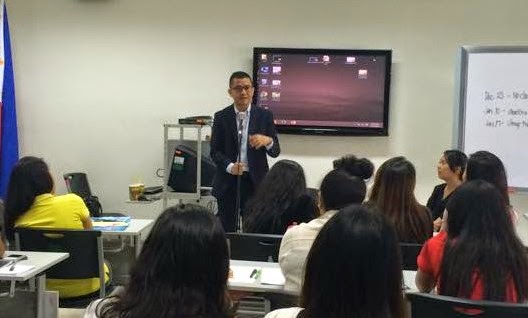.jpg) The Diplomat: Sig
Masangkay, a bona fide FSO IV, validated some of the details in the book by
sharing in class his work in the DFA. He particularly talked more about his
journey in preparing and taking the infamous and much-dreaded foreign service
officers’ (FSO) exam. Though he considers himself as just an ordinary student
in college, he passed the FSO exam in just one take. His personal account while undergoing the
exam process is both enlightening and encouraging.
The Diplomat: Sig
Masangkay, a bona fide FSO IV, validated some of the details in the book by
sharing in class his work in the DFA. He particularly talked more about his
journey in preparing and taking the infamous and much-dreaded foreign service
officers’ (FSO) exam. Though he considers himself as just an ordinary student
in college, he passed the FSO exam in just one take. His personal account while undergoing the
exam process is both enlightening and encouraging.
The Exam: His talk
essentially proclaims that, contrary to popular notions, the FSO exam is not awfully
difficult if one has really prepared for it, just like in any other exams. The various
components of the test, which involves history, law, economics, culture, foreign
language, and current affairs, make it a uniquely challenging intellectual exercise.
There is therefore some semblance of truth to the notion that the DFA may be
looking for a “walking encyclopedia” given the nature of the exam. That is why the
speaker’s ultimate advice is to prepare, which involves hard work,
determination, and a lot of reading.
The Students: Reading the book and listening to the talk generated a lot of
insights from the class about the realities behind a diplomat’s job and the
challenges in the FSO exams. As part of their course requirements, these
students’ wrote exceptional essays that revealed their personal
reflections:
 |
| Students at Miriam College taking up International Studies |
On conquering
doubts in deciding to become a diplomat by Donna Macaraeg:
“Although honestly the talk made
me doubt if I should take the FSO exam since it was very hard on different levels,
the speaker nonetheless convinced me that ‘nothing
is hard just as long as you prepared for it.’ He taught me that sometimes
you just got to swallow all those insecurities and be a man (or in my case a
woman) about it.”
On improving one’s self to become a diplomat
by Alleona Tagle:
“Choosing to become a diplomat involves
developing one’s self. Being a diplomat means I have to improve myself and
become more flexible and ready to face various challenges; become a good
communicator since diplomacy is all about thoughtful speeches and well-crafted
writings; and become more punctual because according to Secretary Roberto
Romulo: ‘Diplomats should arrive at any meeting on time, regardless of traffic
jams or any other alibis.”
On what it takes to become a diplomat by
Sophia Garcia:
“I have learned the importance of having
passion and taking risks. If one does not have the passion to become a diplomat
despite the challenges, then he or she will not have the motivation to actually
become one. Being a diplomat also entails taking risks and stepping out of
one’s comfort zone since ‘taking a risk
is your way to develop yourself.’ Sometimes we get used to doing the same
things without realizing that we are suppressing ourselves from achieving our
potentials as individuals.”
On the
purpose of being a diplomat by Jill Fernandez:
“The purpose of
being a diplomat is not about pride and status in society. It is about genuine
service without the comforts of the home and the willingness to serve the
Filipino people beyond national borders. To put it simply, the point and
purpose of being a diplomat is service to the people and to the nation. It
might be a very difficult endeavor, but surely, it will be worth the sacrifice.”
On the process of
becoming a diplomat by Mia Estipona:
“I realized
something about the foreign service after reading the book and listening to the
speaker. It is ultimately about the process. These diplomats are not who they
are today because of their skills from the very beginning. But they are who
they are today because they went through the process and they are still
continuously being processed. One needs to learn, live, fail, learn again, and
live again. It’s a process--- a process that can truly change a life for the
better if one sees beyond its surface and understand the value and the true
meaning of it.”
The Takeaway: This is
indeed a good reality check and an encouraging push for those wanting to be
part of the foreign service. It is both
an exciting and challenging profession. Deciding to become a diplomat involves
a lot of thoughtful consideration, and finally becoming one requires a lifelong
commitment to represent and serve the nation. In the final analysis, the foreign service may
be a prestigious career but it is ultimately not for the faint hearted.


